Course Objectives
Fundamentals in Research
- Define appropriate academic research.
- Identify periodicals that describe academic research studies related to human services management.
- Discuss important ethical issues in research.
- Apply the scientific method to the field of human services management.
- Describe quantitative and qualitative research methods.
Focusing Your Research Efforts
- Identify legitimate research problems.
- Create a literature review of a research proposal.
- Discuss the scales of measurement used in research.
- Discuss the fundamentals of sampling.
- Identify ways to obtain representative quality data for research.
Quantitative Research Methodologies and Data Analysis
- Evaluate the types of descriptive research designs.
- Describe the types of research designs that can determine cause-and-effect relationships.
- Discuss the use of descriptive statistics in research.
Research Evaluation and Data Analysis
- Describe the purpose and importance of evaluation in research.
- Describe formative and summative types of research evaluations.
- Discuss the use of inferential statistics in research.
Proposing a Research Study
- Write a research proposal.
- Interpret results of basic descriptive and inferential statistics.
- Apply basic applications of conducting statistics using Microsoft® Excel® software.
Week 1: Fundamentals in Research
Part A:Scientific Method & Steps in Scientific Inquiry
Write a 700- to 1,050-word paper describing the scientific method and the steps in scientific inquiry. Address each of the following in your paper:
- Define the scientific method. How does it relate to human services research?
- What are the steps in the scientific method of inquiry or research process? Why must each of these steps be included to support the scientific method? Briefly discuss how the scientific research method was applied in the article you found.
- Summarize how scientifically sound research (in other words, applying the scientific method) supports the function of a human services manager.
Part B: Quantitative & Qualitative Research Methods
Write a 700- to 1,050-word paper describing and comparing quantitative and qualitative research methods.
- Define appropriate academic research.
- Define quantitative research and qualitative research. Explain how they differ, and relate each to the human services field and the scientific method.
- Describe how to decide whether to use a quantitative or a qualitative research methodology. Provide examples of what sort of study is appropriate for each methodology, and explain why.
- Define mixed method research, and describe its strengths. Provide an example of when it is appropriate to apply mixed method research in the human services field.
- Identify an ethical issue in research that was addressed in the article.
Week 2: Focusing Your Research Efforts
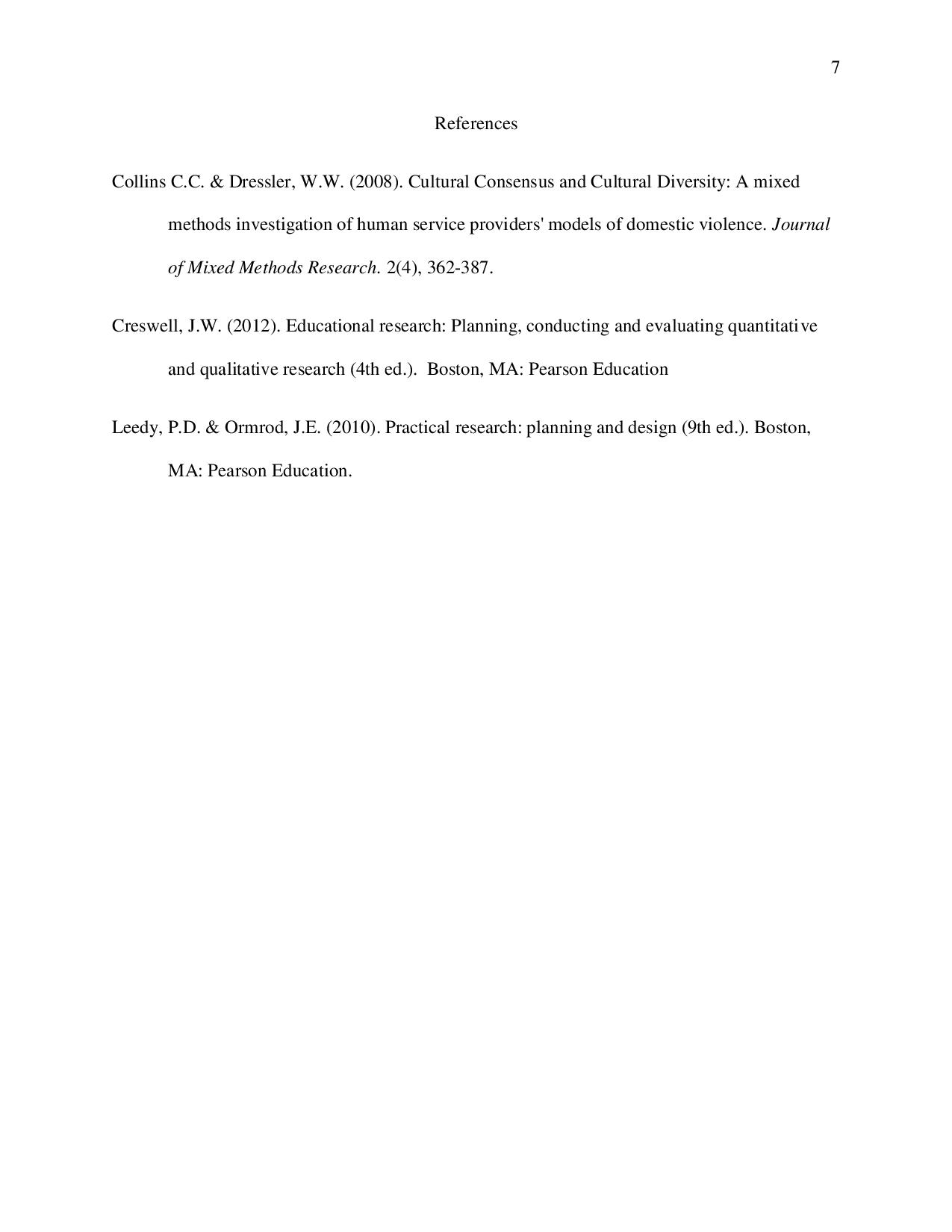
Sampling & Data Collection in Research
Write a 700- to 1,050-word paper describing observation and measurement as they relate to human services research.
Address each of the following points in your paper:
Sampling
- What is the purpose of sampling?
- What are the fundaments of sampling?
- Give an example (characteristics & probability)
- How can you avoid bias when selecting samples for human service research?
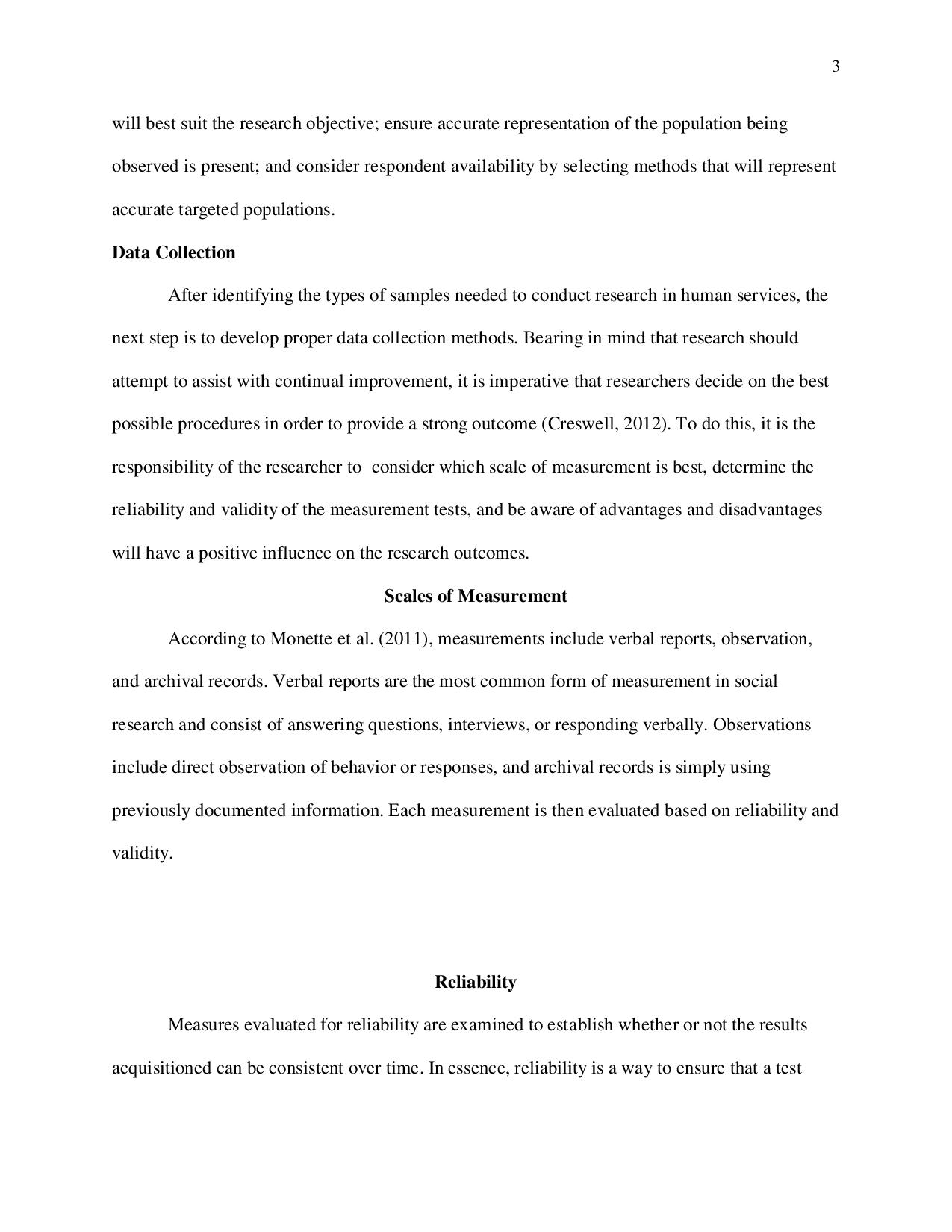
Data Collection
- Describe the scales of measurement used in research.
- What are the types of reliability? Provide examples of the types of reliability as they apply to human services research or to human services management research.
- What are the types of validity? Provide examples of these types of validity as they apply to human services research or to human services management research.
- Why is it important to ensure that data collection methods and instruments are both reliable and valid?
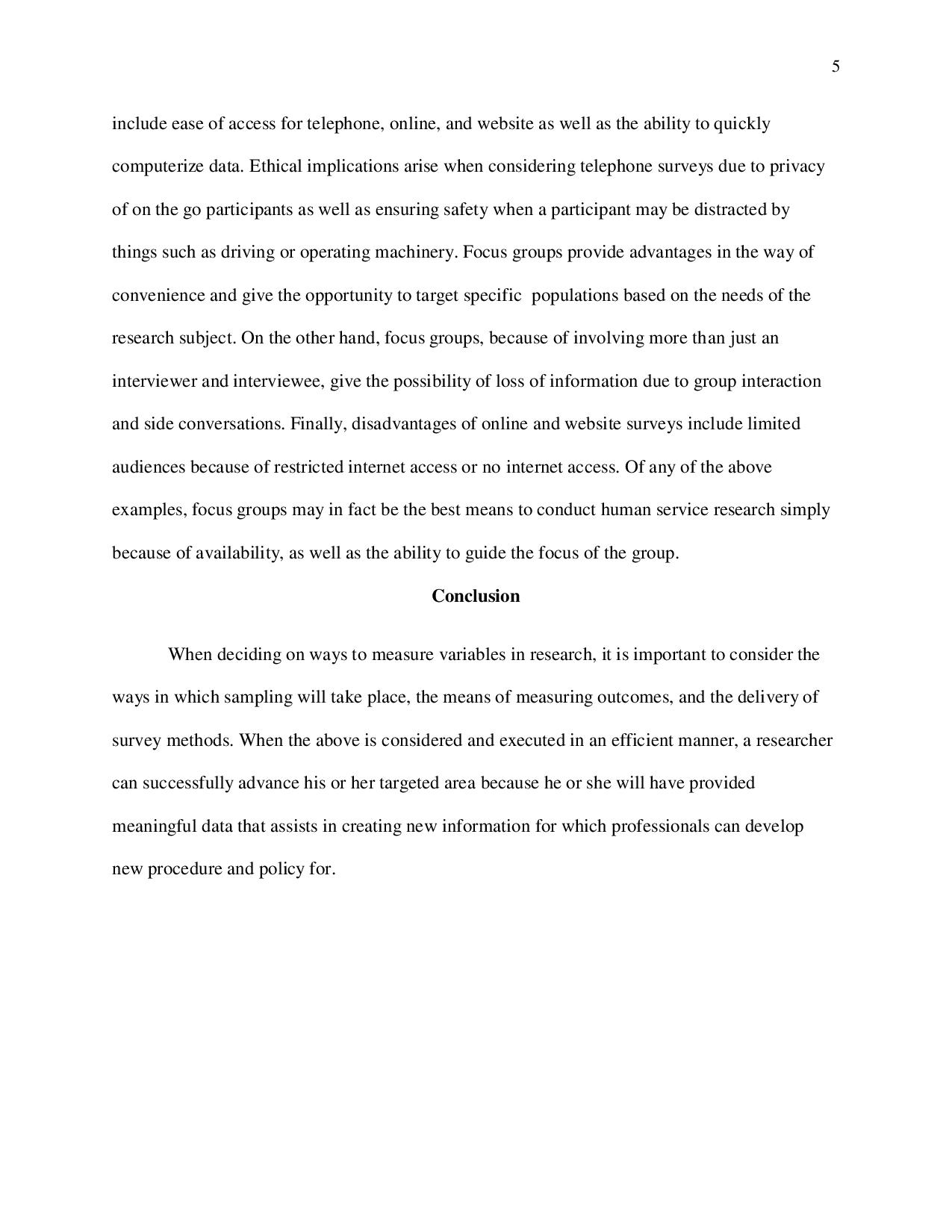
- What are the advantages and disadvantages of each of the following: telephone surveys, online surveys, focus groups, surveys via websites.
- Which of the above examples of survey research would you like to use if you were collecting data and why?
Week 3: Quantitative Research Methodologies & Data Analysis
Correlation as a Measure of Association Summary
Create a 350- to 700-word summary of correlation as a measure of association, including the following topics:
- Describe correlation as a measure of association.
- Describe different methods of establishing correlation between variables, and provide an example for each.
- Explain the advantages and disadvantages of each method and where each must be applied.
- Provide particular circumstances and examples in which a researcher may want to establish correlation.
Week 4: Research Evaluation & Data Analysis
Statistical Analyses
Write a 700- to 1,050-word paper discussing statistical analyses used in the selected study. Include the following in your paper:
- Summarize in 100 to 150 the content of the research study discussed in the article. Provide an APA-formatted citation.
- Discuss in 250 to 400 words the statistical analyses in the article.
- Does the article incorporate graphs or tables that facilitate understanding of the data?
- What descriptive statistics were used in the study? Are the descriptive statistical analyses appropriate for the subject?
- Identify the inferential statistics used, and comment on whether the analyses support the research problem or hypothesis. (For example, do they support the conclusions reached by the author or authors? Are the statistics misleading or biased?)
Final Grade: A-
Everybody get up.mp3